What I'm Thinking When Drawing Live Caricatures.
- AJToonHeadz
- Feb 22
- 9 min read
Updated: Feb 22

I get asked a lot, “What the hell are you actually thinking when you’re drawing caricatures?”
And I wish the answer were simple—but it isn’t just one thing.
My thought process changes every single time someone sits down in the chair. There are a few core ideas I rely on to guide the drawing, but sometimes a new face sparks a new approach—something I’ve never tried before and end up using again later.

So here, I’m going to break down the formulas I typically run through when someone sits down for a caricature. I'll even share some ideas that I have talked about before on YouTube- because I am finally taking the time to write out the thought process...
Which is a difficult thing to do, as most of these ideas just feel like they flow naturally and it's translate it into words. Think about having to teach one to breathe - and you can't use the words " INHALE " or " EXHALE". That's sort of how it feels sometimes connecting the dots of these ideas. So thank you to everyone who has been patient with me and I hope everything below makes some sort of sense...
1. Head Shape
If you want to build a house, you want to make sure you lay down the foundation first. Same goes with drawing someone's face - the head shape is the foundation to the caricature. Now - of course - for me, I like to push it. I want to find dynamic or abstract shapes that resemble the person I am drawing. This is a real challenge as you limited - placing a feature slightly further away from the other can disrupt the whole likeness of the subject. So you need to not only have fun finding an abstract head shape - but also ensure that it can resemble your subject and the dynamic features inside that shape. That is where confidence comes into play. When you just draw some weird looking shape, you have to remain confident that you can keep pushing the features the head shape. THE MORPHING METHOD I recently made a video about the MORPHING METHOD which is an exercise to feel more comfortable with pushing fun head shapes.
This exercise will not only prep you for coming up with dynamic head shapes - but also get you more confident to push your exaggerations! It forces you to really think and get creative - which is a muscle that you need to work up in order to really push exaggeration.
HOTDOG VS. HAMBURGER
Another thing I look for is breaking down the head shape to either resemble a Hotdog or a Hamburger. This allows you to instantly recognize how thin or wide you should draw your dynamic head shape. It will also serve you when you're drawing more than one person on the paper - as 85% of the time drawing live caricatures you will draw more than one person on the page. So this method can also help you with finding fun compositions for your caricatures. Of course, I have another YouTube video explaining this!
FINDING THE MASS / TWO-PART HEADSHAPE
So another good method when someone sits down, I start by breaking the head into two simple shapes—the cranium on top and the jaw on the bottom. I wish I could take credit for this brilliant method, but I was taught the lesson by Tom Richmond from his book
The Mad Art of Caricature - something I HIGHLY recommend getting if you're wanting to learn caricature).

Here's an example of what I mean! Our subject is super bottom heavy. The beard doesn't definitely accentuates this as well. When I rendered the caricature I made a HUGE shape for the bottom mass and a little itsy-bitsy shape for the top.

And sometimes this method can be tricky to solve - which is why you need to trust your instincts. Yet, zooming in you can really tell what section has more mass - which is her extremely round forehead. I really push this idea compared to the bottom shape. DIRECTION
What really helps me push exaggeration is figuring out the direction the face flows. You can also use the direction of the features to come up with a more dynamic head shape.

2. ESSENCE
As much as I used to think caricature was all about visual impression, the longer I do this, the more I realize how untrue that is. What truly makes a person who they are goes far beyond outward appearance. And when you’re able to include a subject’s character along with their caricature, the drawing becomes far more successful.
CHARACATURE (funny right?)
Personality, Behaviors, Mannerisms, Posture, Habits, Confidence, Attitude, Humor, Expressiveness...
How someone sits. How someone smiles. How someone speaks. How someone coneys their thoughts.
Do they Hesitate? Or do they just unconsciously express themselves?
How someone laughs. How someone frowns. How someone cries. How someone gets angry.
Focusing on these details helps you tune in more deeply and opens up new ways to get creative with your caricatures. People are unique, and its a caricature artists job to figure out what actually a person tick.
Some of my favorite caricatures I’ve done are the ones where I felt like I successfully captured who they were as a person.

For example, this awesome customer sat down and I instantly loved his energy. He was bold, confident, hilarious, just a little ditsy—and very Italian.
When I drew him, I wanted to capture that classic “duhh… ey, how ya doin’?” vibe. That’s why I pushed his mouth open and leaned into a character choice inspired by Barney Rubble, pulling that design language into the caricature to help sell who he was as a person—not just what he looked like.

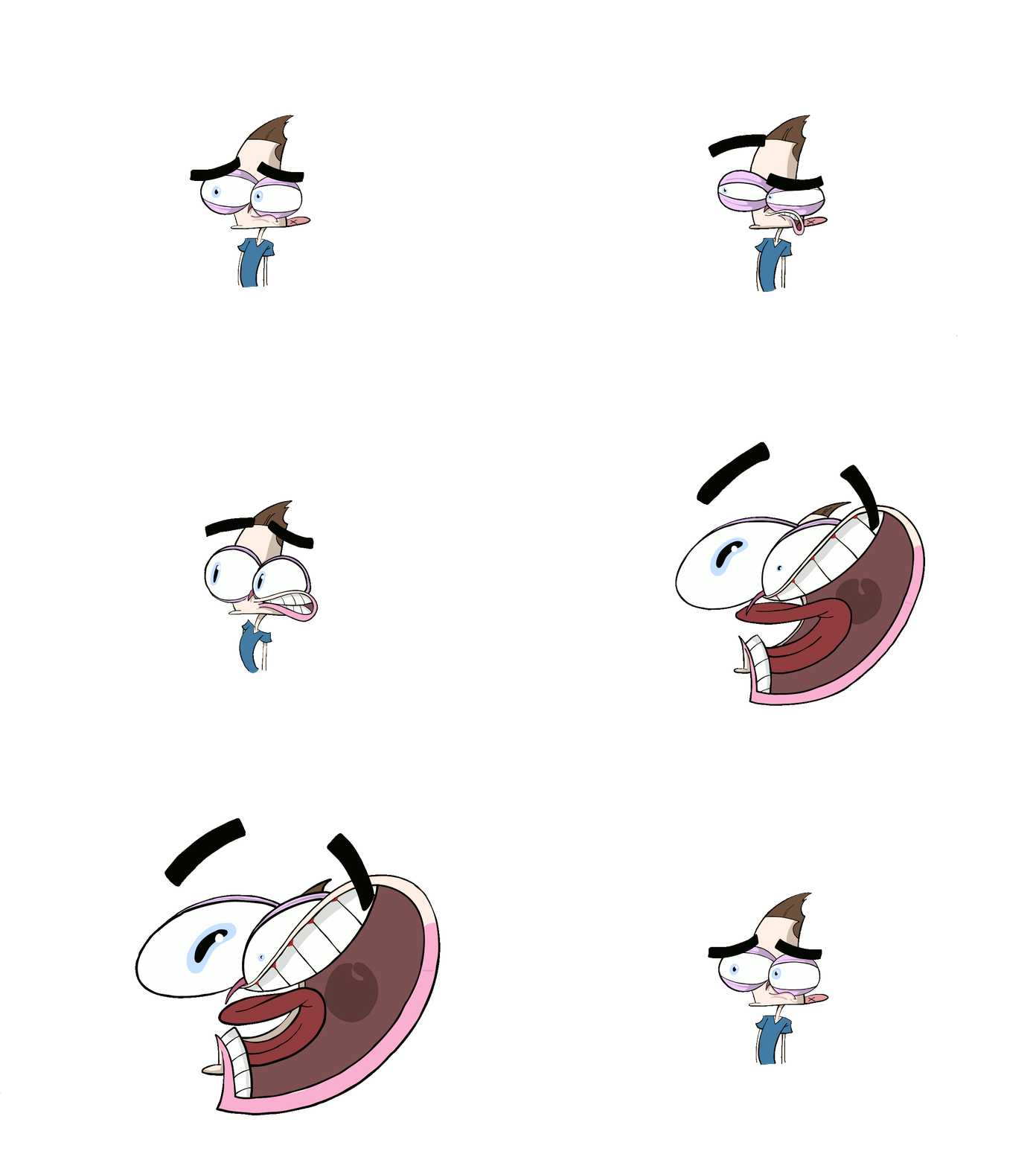
Take this caricature of ToonHeadz artist Blake. He’s quiet, a little awkward, and unapologetically himself—which is exactly what makes him great.
So instead of smoothing that out, I exaggerated it. The forced smile, subtle weird hands, posture, and confused look try to capture Blake's personality as best it can. When I was completely done with the drawing I could almost hear him.
As the caricaturist, you want to capture not just what you see visually but what you feel, hear, and understand about your subject. Just generally speaking of art, the best art includes a story. The great thing about drawing people - is that EVERYONE has a story and what made them, them. When you capture that, you can make a solid caricature. Yet, you could be asking,
"HOW DO YOU DRAW CHARACTER??? "
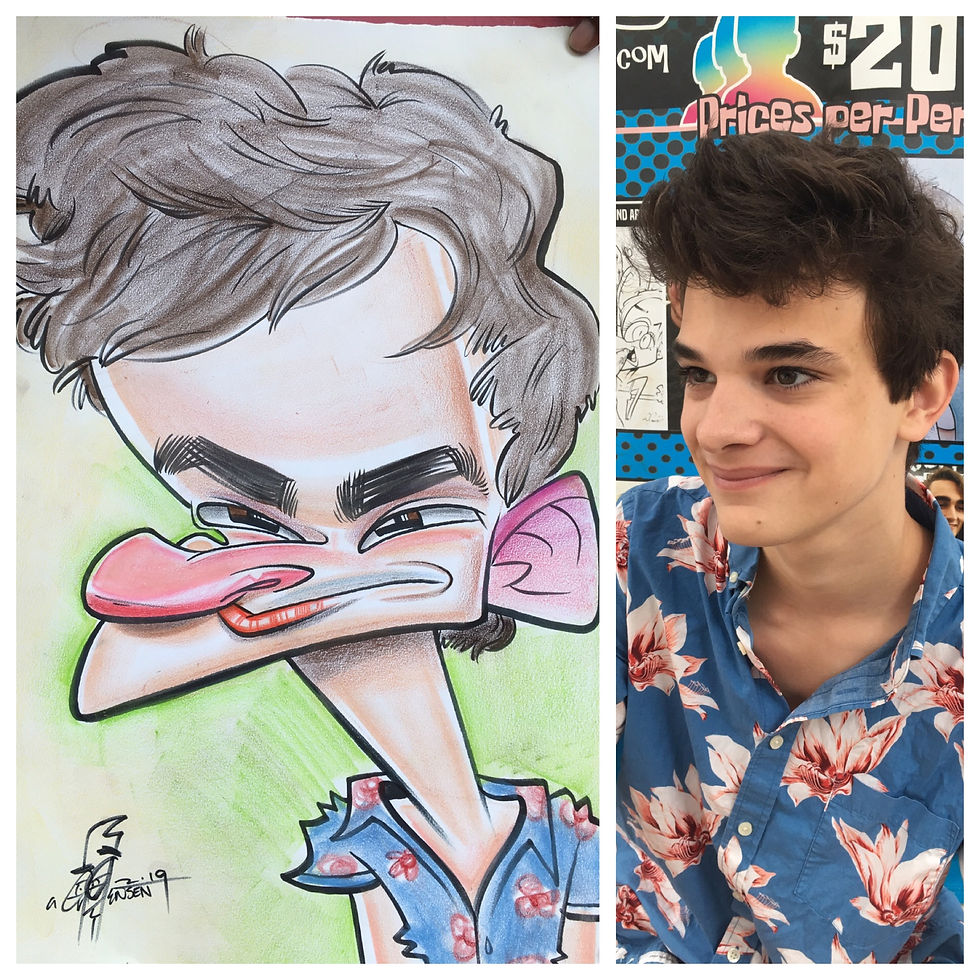
YOU CAN CAPTURE THEIR AWKWARDNESS.
The skinny smirk. The slightly uncomfortable body pose. The energy of the lines. And most importantly, the energy of the person themselves. Just really concentrate on how your subject acts and be observant to how THEY can make you feel as well.

YOU CAN CAPTURE THEIR EXPRESSIVENESS.
People have character, and sometimes they animate that character through their face. The way they talk or smile can give you clear signals about how expressive they are—sometimes incredibly upbeat.
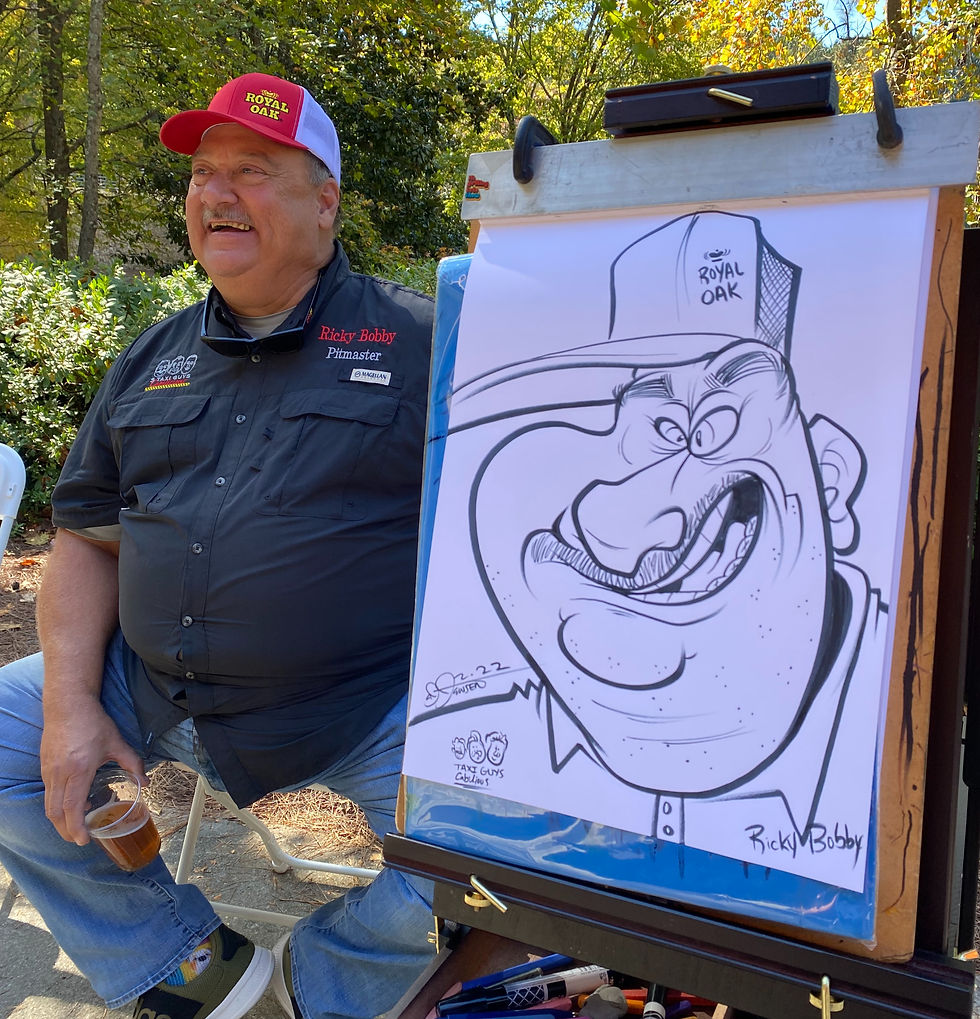
HOW SILLY THEY CAN BE. Some people are just loud, silly, goofy, and overall just cheerful. They live to make people laugh and are very comfortable within their own skin. Capturing them with funny expressions, eyes bulging, and expressive linework can really bring them out.

HOW GOOFY THEY CAN BE.
Push those expressions for the people that sit down and just act whacky. These are the people that are super playful, zany, quirky, and love to hear people laugh. Laughter is almost an approval for them.

DRAW THEIR CUTENESS
Some people are just adorable! They have soft- kind voices, they're interested in making sure everyone feels loved, and they're just cute. You can capture this by imitating other cute cartoon characters like Mikey Mouse.

DRAW THEIR LOVE Some couples genuinely radiate their love—as corny as that sounds. When that energy is there, you can push the composition by pulling the two figures into each other. Their poses can point toward one another, reinforcing that connection, and when you lean into that dynamic, the drawing becomes stronger by reflecting the love they share—not just how they look.

INCLUDE THEIR NOISE
Everyone makes a certain pitch - it being low and reserved to loud and outgoing. You can push their mouth expressions to convey that noise. The more open the mouth the more expressive they are - the more closed the mouth, the more minimal they can be.
Expressions and Body Poses are going to help you the most here.
Again, it all comes down to being observant and creative in how you capture character. If someone talks with their mouth slightly off to the side, include that. If they’re expressive and their hands move every time they communicate, work that into the drawing.
To the average person, these details might seem subtle. But as artists, we understand the level of observation and difficulty it takes to capture them. And when someone who has never met the subject can look at the caricature and immediately understand their character—that’s when you know the caricature is successful.
3. THE FEATURES
I think the second most important thing would be finding what feature calls out to you first. This takes some practice as I believe we have a habit of concentrating on one feature entirely with everyone new. For me it used to be the nose - which is why in the beginning of caricature I would ALWAYS exaggerate the nose - even if it was small. Full honesty, this is a habit I still find myself doing sometimes. So you do have to break that habit when you are learning caricature and realize everyone has their own special feature.
FOCAL POINTS
So years ago, I made a video explaining the significance of Focal Points. Guess what?!?!
I kept saying it wrong through the whole video... cause I'm an idiot... and for some reason the word FOCAL is hard for me to pronounce. I kept saying VOCAL POINTS, hahaha. Whoops😬! Who knows, maybe I can come up with another one.
Elgin Subway Surfer would call this method VISUAL HOOKS - which I use from time to time. Maybe I should just call it that!
If you sat through this video - again - I am sorry for saying VOCAL POINTS like 80,000 times.
ACCENTS
These are the features that aren’t immediately jumping out at you. Each one acts as a puzzle piece that helps communicate who the person is. When you exaggerate these supporting features, you make the caricature more interesting, more fun, and more expressive overall.
Accent Features help the Focal Features stand out more!
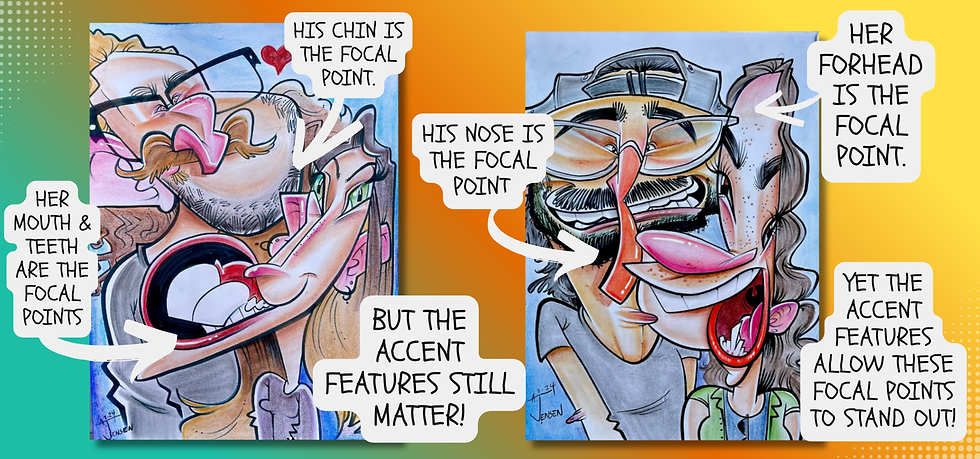
Now, I will say this—I’ve seen caricatures where only the main feature was captured, with all the accent features left out, and the caricature still worked. But if you think about it like playing a video game, that’s basically super hard mode. One wrong move and you’re starting all over again. Yet, usually the ones I see are by iconic people.
FEATURE VARIATION/ SIZE
Okay! So here is the secret sauce for really pushing exaggeration!!!
This is where you want to have each feature have a variety of sizes. If you keep all features relatively the same size, you are not displaying as much exaggeration. Honestly, this is a very tough thing to start doing - as we are not really pushing the sizes of those features when we first start.

HERE IS A PERFECT EXAMPLE!
One of these drawings shows not that much variety between features. The eyes, mouth, ears, and head shape are pretty much the same in size - which doesn't convey how big the nose is - it just looks similar to all the other features.
The other drawing, however, uses hierarchy. By shrinking the eyes, mouth, and face - the nose immediately feels HUGE! Each feature has variety, which can make you Focal Point Feature look bigger. So if you want a feature to look bigger - have the surrounding features smaller.

IN THIS DRAWING THE NOSE IS THE SPOTLIGHT OF THE SHOW. You can see that I used a variety of sizes across the features, rather than keeping everything the same scale. Each feature plays a different role, which creates a hierarchy.
Nose — Size 5 (dominant feature)
Jaw — Size 4
Eyes — Size 3
Ears — Size 3
Eyebrows — Size 2
Forehead — Size 2
Mouth — Size 1
This range of scale creates contrast, guides the viewer’s eye, and makes the caricature feel more dynamic instead of flat.
DISTANCE
Measuring the distance between features will help you understand where to place your features in an exaggerated caricature. I was able to do a fun Caricature Tip video that is on YouTube to demonstrate this idea.
PINCHING AND PULLING
Some features will naturally stick out farther than others. The Direction Method we talked about earlier can really help you judge how far a feature projects or recedes in space, instead of treating everything as flat. Looking at the direction of the forms allows you to better understand depth and gives you clearer information about what should come forward and what should fall back.

Once you recognize that depth, you can start pinching and pulling the features accordingly. Features that project can be pushed forward, while receding features can be compressed or tucked back. This push-and-pull adds dimension, strengthens the structure, and helps the caricature feel more alive rather than stiff or evenly spaced. ANGLE
All features have some sort of angle going on with the face - and you can exaggerate that angle further to make it resemble more of your subject. Understanding the angle of these features can also help you find more organic and dynamic shapes to resemble that feature.

Now I struggle with separating the methods of DIRECTION and ANGLE. Yet, I think Direction apples to the overall flow of the face - while Angle is specific to just the facial features. Using both together sort of ups your ante on finding fun exaggerations and shapes.
Of course, there are plenty more fundamentals and ideas I apply to each caricature! Yet, those will come later! But for now, I hope these help you on your caricature journey. Thanks!


Comments